Nobel Laureate Steven Chu Warns of ‘Titanic’ Climate Challenge
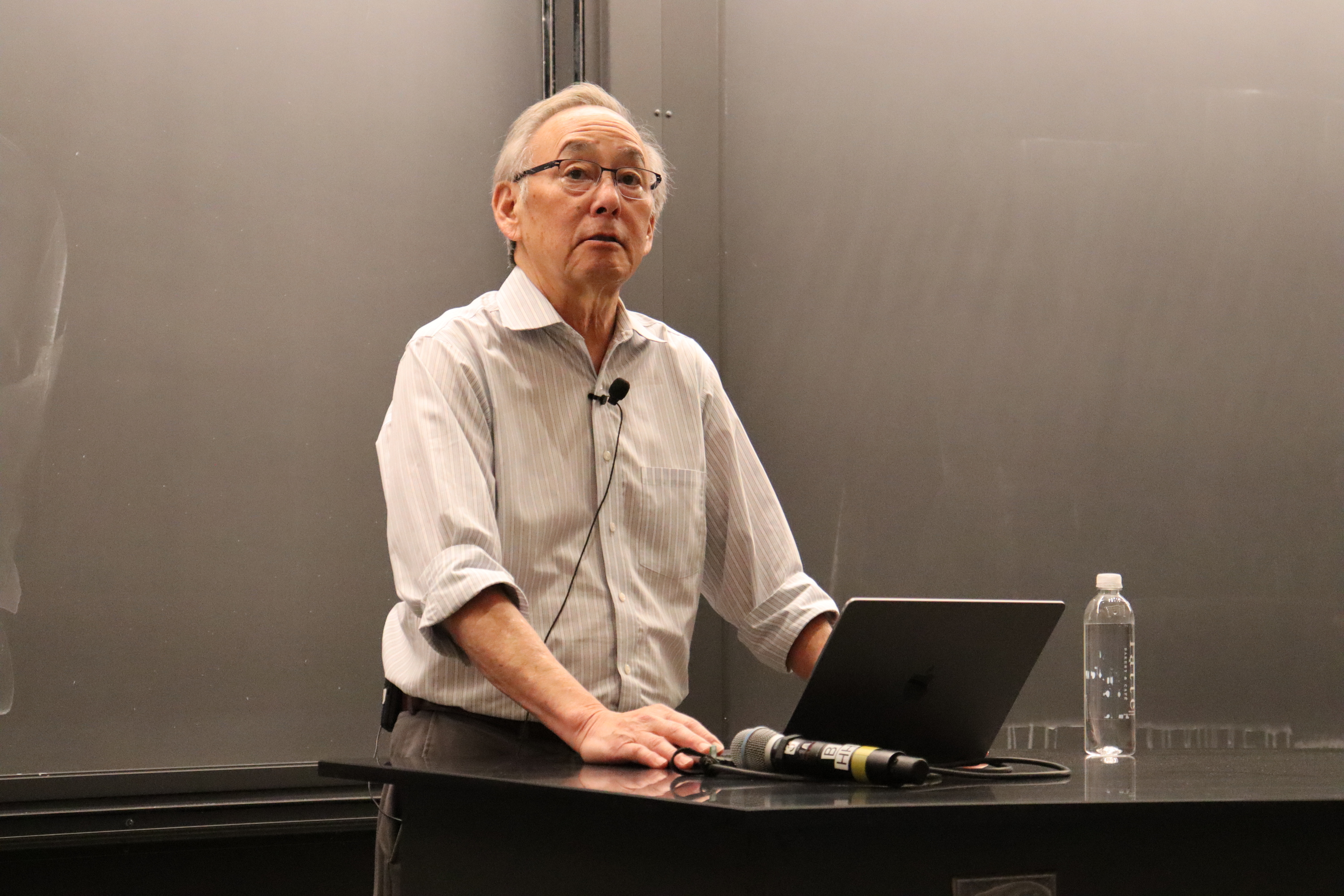
On Monday, Nobel laureate and former U.S. Energy Secretary Steven Chu delivered a wide-ranging and urgent lecture, warning that the world is on track for catastrophic levels of warming, calling for a new era of scientific innovation and policy action to meet the challenge of net-zero greenhouse gas (GHG) emissions. Chu’s lecture, “The Challenges in Getting to Net-Zero GHG Emissions,” helped to kick off Harvard’s Climate Action Week.
The event was co-hosted by the Department of Chemistry and Chemical Biology (CCB) and the Salata Institute for Climate and Sustainability.
Deana Reardon, Executive Director of Chemistry and Chemical Biology, highlighted the importance of such events for CCB and the broader scientific community.
“Innovative breakthroughs in chemistry and chemical biology are at the core of addressing climate change, from developing next-generation energy technologies to reimagining sustainable materials,” Reardon said. “By bringing leaders like Dr. Chu to campus and hosting symposia like this, we ensure our students and researchers are inspired and prepared to help translate scientific discovery into global climate solutions.”
James Stock, Vice Provost for Climate and Sustainability and the Harold Hitchings Burbank Professor of Political Economy, welcomed attendees to the first of over thirty events scheduled throughout the week.
“We are thrilled to have Dr. Steven Chu launching both Climate Action Week and Climate Crossroads,” Stock said. “Our vision is to bring diverse voices to critical conversations shaping the global energy transition.”
Xiaowei Zhuang, David B. Arnold, Jr. Professor of Science, and a former postdoctoral fellow in Chu’s lab at Stanford, introduced Chu, praising his historic impact across physics, biology, and engineering.
“Steve’s career is a true testament to the role of science and education in the betterment of humanity,” Zhuang said. “His research and leadership have not only expanded the frontier of knowledge, but also has addressed some of the most pressing challenges the world is facing now.”
Chu’s lecture delivered a sobering analysis of humanity’s climate trajectory, moving from the industrial revolution’s historical legacy to today’s formidable decarbonization challenge.
Chu began with a stark reminder: global temperatures are nearly certain to blow past the 1.5°C warming threshold this decade, as decades of greenhouse gases already emitted will continue to heat the planet for over a century, a phenomenon he likened to the delayed health impacts of heavy smoking.
“Holding steady is not good enough,” Chu said. “We have to reverse the temperature.”
He underscored the complexity of reaching net-zero emissions by 2050, highlighting persistent emissions from sectors such as agriculture, steel, and chemicals, and warning of the growing threat of climate refugees and global food insecurity.
“Food production is an unsolved problem,” Chu said, explaining that advances in synthetic biology may ultimately be required to reduce the climate impact of agriculture.
He also emphasized the need for innovation in energy storage, grid integration, and affordable carbon capture technologies. Drawing on decades of materials science breakthroughs—from semiconductors to fiber optics—Chu called for a new era of innovation, focused on decarbonizing everything from electricity to transportation to building materials.
Throughout his address, Chu balanced optimism about technological progress—citing rapid advances in batteries, renewables, and electric vehicles—with realism about the pace of systemic change.
Chu likened society’s efforts to steer away from disaster as turning the Titanic after the iceberg is spotted.
“The moral of the story is it's going to take 60 to 75 years to turn the ship, Chu said. “It's going to take a while, and we do need innovation.”
Chu fielded questions from attendees on a range of topics from the promise and pitfalls of artificial intelligence to the comparative benefits of different materials in sustainable construction.
The Harvard Climate Action Week programming continues through April 21.