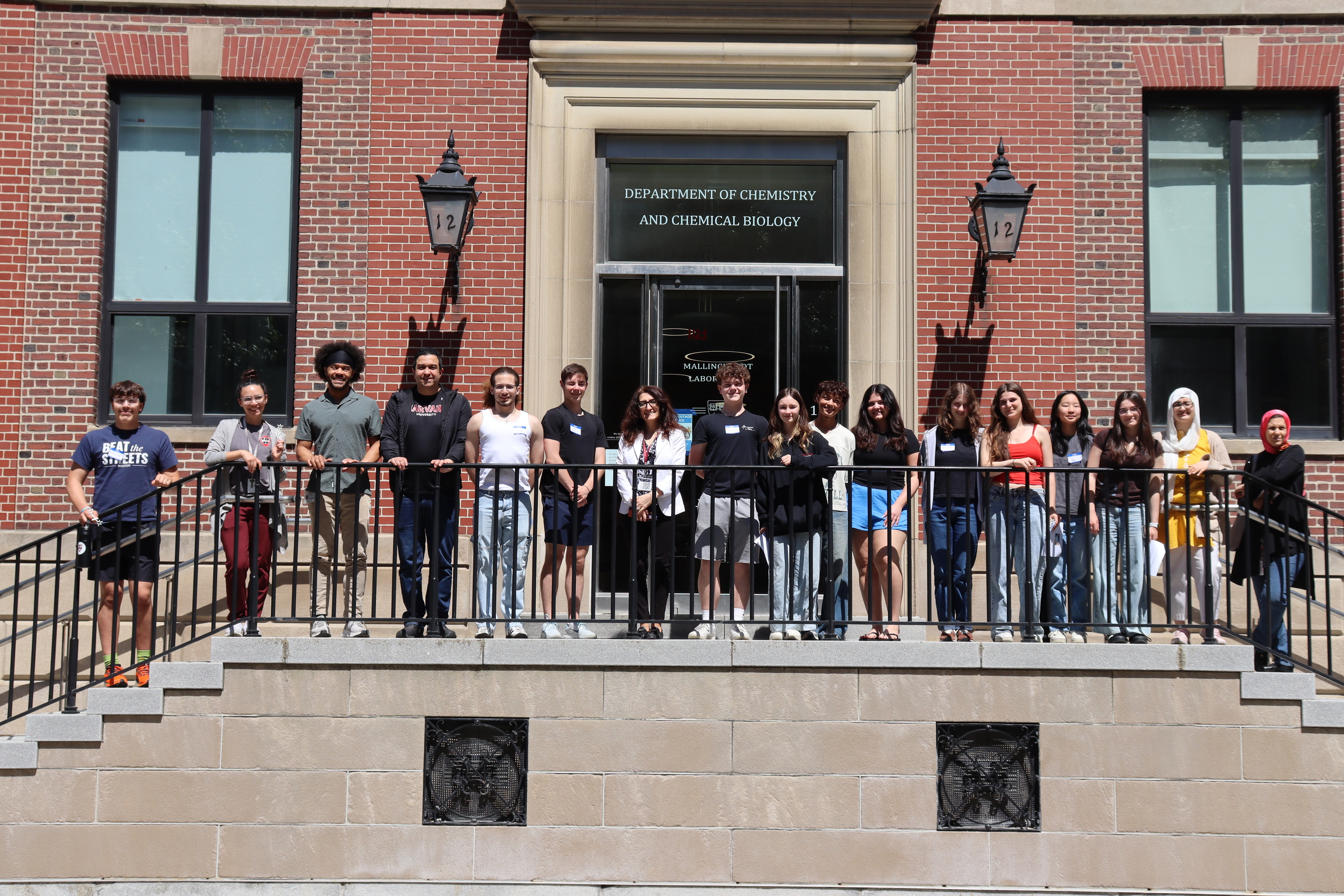
CCB launches new K–12 outreach partnership with Watertown High School
On Thursday, June 4, the Department of Chemistry and Chemical Biology’s Advanced Undergraduate Teaching team welcomed 12 AP-level students from Watertown High School for the inaugural visit of the new CCB Advanced Teaching Labs K–12 Outreach Program. The half‑day program, held in Pfizer Lecture Hall and neighboring facilities, introduced students to university‑level chemistry through hands‑on, research‑informed activities designed to make STEM feel both accessible and exciting.
“We launched this initiative as part of our commitment to expanding access to high‑quality STEM education beginning in K–12,” said Dilek Dogutan, Director of Advanced Undergraduate Labs. “We wanted to use our teaching labs, expertise, and educational tools to support and inspire students in neighboring communities, particularly those who may have limited exposure to university‑level science.”
The visit began with a welcome and introduction to the history of CCB, followed by a department tour that spotlighted major research facilities, including the Laukien‑Purcell Instrumentation Center (NMR Facility) and the Center for Crystallographic Studies (X‑ray Core). Students learned how techniques such as NMR spectroscopy and single‑crystal X‑ray crystallography are used to investigate complex molecular systems.
Back in Pfizer Lecture Hall, the teaching team introduced “molecules of life,” focusing on chlorophyll in photosynthesis and heme in oxygen transport. Students compared one‑, two‑, and three‑dimensional representations—including blackboard structures, slides, and 3D‑printed models—before donning virtual reality headsets to explore these molecules in immersive 3D. During a Nanome VR workshop, students worked in small groups to visualize atoms, bonds, molecular geometry, and electronic configurations, and to connect molecular structure to function.
This new K–12 effort complements a broader portfolio of CCB outreach and educational programs that engage learners across the pipeline. For undergraduates, CCB’s Foundational Undergraduate Experiences in the Laboratory (FUEL) program immerses pre‑concentrators in an intensive research environment that blends hands‑on laboratory training with professional development, computational tools, and a capstone poster presentation. At the high school level, CCB’s High School Lab Pathways Summer Research Program, in partnership with the Harvard Ed Portal, provides Brighton High School students with an experiential introduction to scientific research, pairing them with graduate student mentors and incorporating both science literacy instruction and authentic laboratory work.
Feedback from the first Watertown cohort has been overwhelmingly positive. Watertown High School STEM lead Maha Hassan wrote that students were “absolutely fascinated by the laboratories they visited and the incredible science behind the fundamental molecules of life,” adding that the visit gave them “a rare and invaluable opportunity to step into the shoes of true researchers” and “inspired the next generation of STEM leaders.”
Dogutan emphasizes that this is only the beginning. The team is collecting structured feedback from students and teachers and plans to expand to more schools, develop new modules that connect chemistry to societal challenges, and deepen partnerships with educators. “Ultimately,” she said, “we want this outreach program to be a sustained, evolving effort that supports K–12 STEM education, broadens participation, and helps students see themselves as future scientists, engineers, and informed citizens of this planet.”