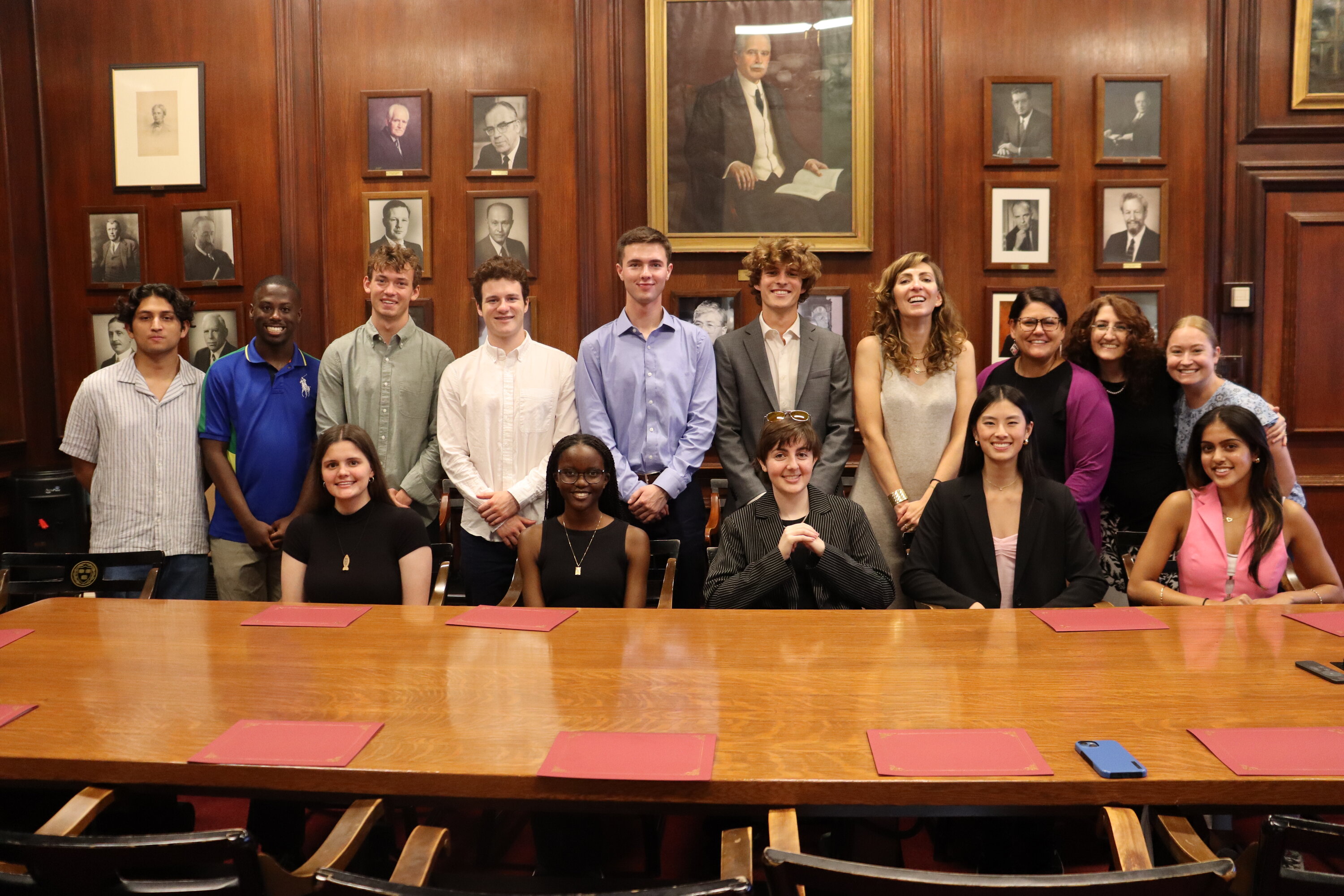
CCB celebrates inaugural Foundational Undergraduate Experiences in the Laboratory program
Harvard’s Chemistry and Chemical Biology (CCB) Department celebrated the success of its first Foundational Undergraduate Experiences in the Laboratory (FUEL) program on Wednesday, August 7th, with a poster session and certificate presentation. The event marked the culmination of a 10-week research initiative that immersed ten rising sophomore Harvard students in intensive lab work, professional workshops, networking, and hands-on research experience.
For its inaugural summer session, CCB FUEL ran as a Harvard Summer Undergraduate Research Village (HSURV)-adjacent program. “We were able to utilize the incredible and formalized structure within this HSURV established program, while also creating an experience that was fully supported, staffed, and funded by our department,” said Deana Reardon, CCB’s Executive Director. This took a significant commitment from CCB faculty and administrative leaders and continues to showcase the department’s firm commitment to creating opportunities for undergraduates.
FUEL targets pre-concentrator undergraduates with a strong interest in life sciences research, offering a comprehensive package that includes a stipend, housing, and meals on campus, which ensures that students can fully focus on their research and professional development. Participants were also encouraged to engage in Village-wide activities, fostering a sense of community and collaboration among the broader group of summer researchers.
“The CCB FUEL program is really a celebration of a multi-year planning effort to focus on increasing undergraduate access to hands-on laboratory experiences earlier in their college experience,” said Reardon. “It started as a white paper written in 2021, which morphed into an introduction of a ‘Blue Sky’ Program in 2022, then into a request to create a new seminar in spring of 2023. Finally after all this planning, we were able to create an immersive undergraduate research program in Summer of 2024. That history is important because it has taken an unparalleled commitment to undergraduates to make this happen. And we have phenomenal CCB personnel leading that effort in Lecturers Sien Verschave and Dilek Dogutan-Kiper with support from Professors Dan Kahne and Dan Nocera.”
The white paper, written by Kahne, Reardon and Verschave, establishes the foundation behind the problem they wanted to solve: “Less than half of students who enter US colleges each year intending to major in a STEM field actually end up graduating with a STEM degree, and women and under-represented minorities are far more likely to drop out of STEM.” Retention of students in STEM fields is strongly correlated with exposure to research early in college and with a learning environment that fosters peer-to-peer mentoring. They proposed that Harvard (and specifically CCB) needed to provide more opportunities for students – and especially those under-represented in STEM – to start research early in their college careers, and it needed to establish learning communities in which these students could thrive.
They recognized that CCB had one of the largest concentration of researchers in the life sciences at Harvard but there was no structure in place to guide first-year students into appropriate labs, nor to support them once they joined a lab. They found that students who do not have prior experience working in a lab were at a particular disadvantage. This group of students disproportionately includes students from backgrounds that are underrepresented in science. Often, these students never get the opportunity to join a lab and do research during their undergraduate education.
In their 2021 white paper they proposed to “restructure the life sciences curriculum so that during their first year in college all our students gain the knowledge required to join a lab. Our undergraduates who do not enter Harvard already equipped to join a lab are effectively sidelined until after their sophomore year when their introductory coursework has been completed. By this time, many have left STEM. [We also] need to guide students into CCB labs, and we need to leverage existing resources to provide a high-quality research experience that prepares our undergraduates for a career in STEM.”
CCB facilitated the creation of the freshman seminar course, FYSEMR 52T: Learning How to Think Like a Scientist: An Introduction to Scientific Research. The course was taught by Lecturer Sien Verschave and Professor Dan Kahne, and featured a number of guest faculty lecturers from CCB (Eric Jacobsen, Ted Betley, Emily Balskus, Dan Nocera, Eugene Shakhnovich, Jarad Mason, George Whitesides, and Dilek Dogutan Kiper), MCB (Carolyn Elya), and Harvard Medical School (David Rudner, Suzanne Walker, Tom Bernhardt). This seminar became a prerequisite for the FUEL experience and laid the groundwork for summer immersion, sparking students’ interest in advanced scientific research and providing them with a solid foundation of knowledge. “The first-year seminar focused on developing reasoning skills to prepare students to engage in scientific research early in their college careers. We also wanted to explicitly reveal some of the hidden curriculum that can be especially opaque and intimidating to anyone new to the world of research.” Verschave explained.
Demystifying scientific literature was another core goal of the seminar. For a final project, students read and presented a scientific paper after meeting with a member of the Harvard faculty who authored of the paper. “This was a highlight for most students,” said Verschave. By the end of the semester, students were ready for the CCB FUEL Summer Program.
During the 2024 Summer FUEL program, students received training in a variety of essential laboratory techniques that will be crucial as they pursue advanced studies and careers in scientific fields, including common biotechnological and chemical techniques. They were also trained on various widely used lab equipment and instrumentation.
“This program was created to bridge the gap between undergraduate classroom learning and academic research,” said Dogutan Kiper. “Our mission is to provide our undergraduate students the tools, mentorship, and experiences that will empower them to confidently pursue scientific discovery, and to create new knowledge in advanced academic research labs.”
FUEL included a “Lab Match Challenge,” an initiative that connected students with Harvard faculty and research labs, offering them valuable networking opportunities and a chance to establish relationships with potential mentors. The connections formed during the Lab Match Challenge are expected to open doors for future research positions and collaborations. The poster session provided a platform for the participants to showcase the knowledge and scientific visualization skills they practiced over the summer. The event included a keynote address from Daniel Nocera, Patterson Rockwood Professor of Energy, who thanked the students for their efforts and presented them with certificates of completion.
“We’ve spent three years refining this program to where it is today, and this is just the beginning. To sustain undergraduate research, we need broad support from across the sciences and I know that Harvard is committed to that goal,” said Dan Kahne, Department Chair and Higgins Professor of Chemistry. “Our students have a broad range of interests, and we’d like to be able to match any student that comes into the sciences with an opportunity to do research with one of our faculty. Anyone seeking this opportunity should have access. That will take cross-school support and commitment. We already have incredible partners at the medical school who are excited about this program and our hope is to continue to expand.”
At the start of the fall term, 102 students had expressed interest in joining the freshman seminar 52T, which had a previous cap of 15 students. “We’re blown away by these numbers. This confirms the importance of sustaining this program and creating others like it,” said Kahne. “I’d say this inaugural program was a success.”
Picture from the celebration: