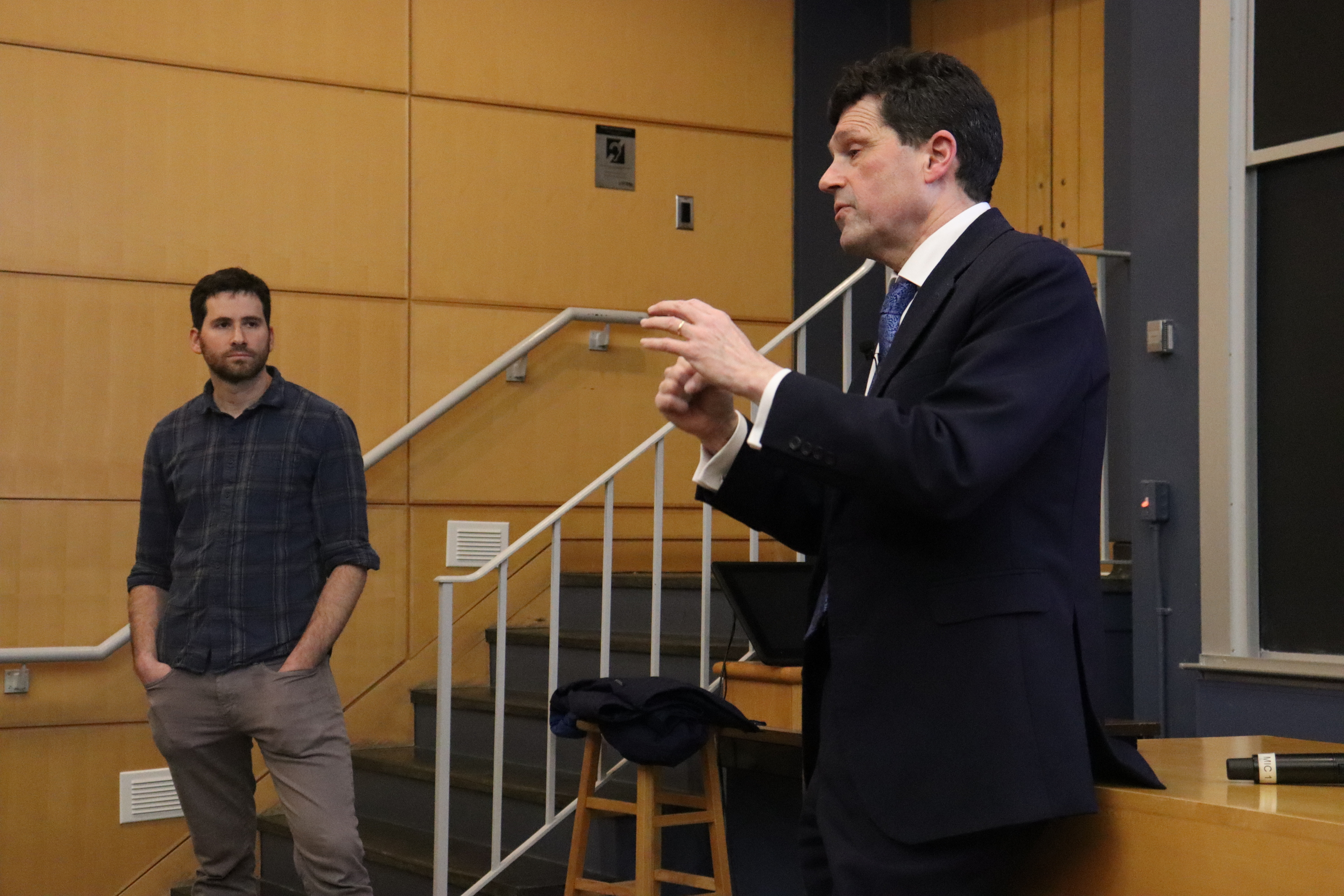
Matthew Rosseinsky delivers George B. Kistiakowsky Prize Lecture
On Thursday, November 21, Matthew Rosseinsky, Professor of Inorganic Chemistry at the University of Liverpool, delivered his George B. Kistiakowsky Prize Lecture entitled "Discovery synthesis of inorganic functional materials in the digital age." Kistiakowsky was a Ukrainian-American physical chemistry professor at CCB who participated in the Manhattan Project and later served as President Dwight D. Eisenhower's Science Advisor. The Kistiakowsky Prize Lecture has been awarded annually by CCB since 1971.
Rosseinsky's lecture addressed the role that machine learning and crystal structure prediction can play in the realisation of new materials, focussing on their use as tools in supporting decisions made and hypotheses created by chemistry researchers. This is illustrated by the discovery (i.e., the experimental synthesis in the laboratory) of an inorganic solid with a high lithium conductivity that arises from its unique structure. The material provides a different perspective on how ions can attain high mobility in solids (Science 383, 739, 2024; Angew. Chem. Int. Ed. 63 e202409372 2024). The scope of potential advances is illustrated with the demonstration that it is now possible under clear assumptions to guarantee to predict the crystal structure of a material based solely on its composition (Nature 619, 68, 2023) and to use automated reasoning to explore chemical space (Angew. Chem. Int. Ed. 2024, e202417657).
Matthew Rosseinsky obtained a degree and a D. Phil in Chemistry from the University of Oxford in 1990. He was a Postdoctoral Member of Technical Staff at A.T.&T. Bell Laboratories then in 1992 was appointed University Lecturer in Chemistry at the University of Oxford. In 1999 he moved to the University of Liverpool as Professor of Inorganic Chemistry. He was elected a Fellow of the Royal Society in 2008. He was awarded the inaugural de Gennes Prize for Materials Chemistry (a lifetime achievement award open internationally) by the Royal Society of Chemistry in 2009. He was awarded the Hughes Medal of the Royal Society in 2011 and its Davy Medal in 2017. He received the 2023 Eni Energy Frontiers Award for the digital design and discovery of next-generation energy materials from the President of Italy. He was recognised in the 2024 King’s Birthday Honours List as an Officer of the Order of the British Empire (OBE) for services to materials chemistry research and innovation.
He was a member of the governing Council of the Engineering and Physical Sciences Research Council (the UK funding body in physics, chemistry, engineering, computer science and mathematics) from 2015 – 2019, and of the Science Minister’s Advanced Materials Leadership Council from 2014-2016. He chaired the Nomination Committee of the Royal Society in 2018.
His work focuses on the synthetic chemistry, design and discovery of solid-state materials, which have applications ranging from catalysis to superconductivity. His group is developing new methods of identifying functional materials, emphasising the integration of experiment with computational methods spanning physical and computer science. His work has been characterised by extensive collaboration with many academic and industrial colleagues.
Pictures below: